
Proof of Concept: The First Wins That Changed Everything: 30 Year Anniversary Series
Early Projects and First Wins
In the early 1990s, the idea of voluntarily leaving water in the river wasn't just novel — it was, to many settlers in the West, nearly incomprehensible.
The Deschutes Basin had been built on a simple premise: water in motion, water diverted, water put to beneficial use. For generations, the measure of a well-managed system was how reliably it delivered water from the river to irrigation fields. The idea of a “beneficial use” that left water where it naturally flowed, sustaining instream habitat and the riparian ecosystem, was not how the system had been designed to function.
And yet, in 1992, a small group of people with diverse backgrounds and competing interests came together to form the Deschutes Basin Working Group, united by a shared question: could they proactively work together to rebalance the system so that both ecosystems and communities would have a future?
The First Irrigation Lease
As drought gripped the Deschutes Basin, Bob Main of the Oregon Water Resources Department brokered an arrangement that few could have imagined just years before: the Bend MetroParks and Recreation District voluntarily chose not to use their water allocation, instead directing 1.5 cubic feet per second (cfs) back into Tumalo Creek. At the same time, another 1 cfs was exchanged between Deschutes River streamflow and Tumalo Creek. This 2.5 cfs was a flexible use of water among diverse stakeholders.
This first project was proof of a concept — that a water rights holder had chosen to voluntarily forgo a portion of their allocation for the benefit of the river. This project proved that the legal framework intended to protect rivers and streams, newly established by Oregon’s 1987 Instream Water Rights Act, had functioned as intended. Instream flow could now be recognized as a beneficial use, and the leasing program had proven to be beneficial to both the farmer and the river.
To the people working on this effort, it was more than a transaction. It was the beginning of a new way to operate. What started as just a trickle, has grown over the years to provide life-sustaining impact to rivers and streams across the basin.
Skepticism Was the Starting Point
It is not easy, looking back, to fully appreciate the resistance these early innovators were met with.
The cultural context of water use in Central Oregon runs deeper than policy or habit. It is generational. Families have built livelihoods and communities around irrigation infrastructure that their grandparents hand dug from the desert land. The canals, the ditches, the seasonal rhythms of diversion and delivery, these are not just systems. They are a way of life, an identity. For decades, the dominant belief held that water left in the river was water wasted. "If there's water in this creek, you're not doing your job," the saying went. Diversion was stewardship. A functioning system meant maximum delivery, and the river itself was not part of the equation.
Cultural values like these do not shift quickly, and they rarely shift in response to force and argument. They shift when people see a different way, modeled by someone they trust — a neighbor, a fellow irrigator, a person who has worked the same land and faced the same pressures. They shift when an alternative is offered that doesn't require someone to give up their values. And they shift slowly, one relationship at a time.
This early Working Group understood this. Their approach was not to convince skeptics through debate, but to demonstrate what is possible through action. Voluntary, collaborative, and non-litigious. Just a willing landowner, an honest conversation, and a handshake deal that left both parties better off than before.
The First Piping Project: A Different Kind of Efficiency
Alongside this early partnership, a complementary approach was gaining interest: what if, instead of simply asking irrigators to use less water, you helped them lose less water in the first place?
The Deschutes Basin’s irrigation infrastructure — over 700 miles of open earthen canals, hand dug over a century ago through porous volcanic soils of Central Oregon. In this landscape, water loss was a fact of life. Water that left a diversion point at the river didn’t always arrive at its destination. Up to 50% seeped into the ground or evaporated under the high desert sun before arriving at its destination.
Piping those canals — replacing open ditches with enclosed pipe — dramatically reduced those conveyance losses. For irrigators, it meant more reliable delivery of the water they were already entitled to use. And crucially, the water that was no longer lost to seepage and evaporation would no longer need to be diverted from the river and could be protected as instream flow.
Some of the first piping projects completed in the Deschutes Basin came through partnerships with local irrigation districts. Working with Tumalo Irrigation District, early projects conserved 5.82 cfs of flow. A similar effort with Three Sisters Irrigation District conserved an additional 1.5 cfs. Both projects were funded through a combination of district contributions and public dollars.
What made this approach politically workable was its symmetry: irrigators received a tangible benefit —reduced water loss, more reliable supply, lower operational demand, and pressurized delivery to farms — and the river gained flow where it had previously lost it. It was a trade that left both sides better off than before.
This “mutual benefit” framing would become one of the defining features of the DRC’s approach for decades to come.
The First CFS of Restored Flow
There is something particular about the moment when a dry reach of river fills again.
It doesn’t announce itself. It doesn’t arrive with fanfare. It moves, as water does, quietly — seeping into gravel, filling pools, finding the low places. But for people who have watched a river diminished, who have walked streambanks more dusty than damp, who have waited to see whether this idea of collaboration would actually translate into something real, the return of flow is not a small thing.
What these early projects demonstrated was that the theory and approach was sound. Water rights could be leased voluntarily. Infrastructure could be modernized with shared benefit. Instream flow protections could be applied and honored without damaging the livelihood of our communities. The pieces of the puzzle that Chapter 1 described — the legal tools, the collaborative framework, the shifting recognition that rivers had needs too — could actually be assembled into something that worked.
It didn’t solve everything. The basin remained overallocated. Many reaches still ran low or dry in the summer. The relationships that would eventually produce more comprehensive solutions were just beginning to form. But something had changed.
People had seen it work.
What Changed, and What Didn’t
The early years of the Deschutes Basin Working Group were defined by a particular kind of trust-building — slow, iterative, grounded in relationship rather than regulation.
The organization was not trying to restore a river at the expense of ending irrigated agriculture. It was not trying to override existing water rights. It was not imposing an environmental agenda on communities that hadn’t asked for one. It was asking a simpler question: given everything this basin needs — farming, fish and wildlife, growing communities, a livable climate — is there a way to do better than we’re doing now?
That question, asked with patience and in good faith, began to shift the conversation. Not universally, not overnight. But incrementally, the way a river shapes a canyon — through persistence, not force.
By the mid-1990s, the model was maturing. Leasing arrangements were becoming more predictable. The organization was gaining credibility with irrigators, agencies, and tribes alike. Federal authorization, which would come in 1996 through legislation introduced by Senator Mark Hatfield, signaled that this work had earned recognition beyond the basin itself.
The tools were still simple. The scale was still modest. But the foundation was being laid for everything that would follow.
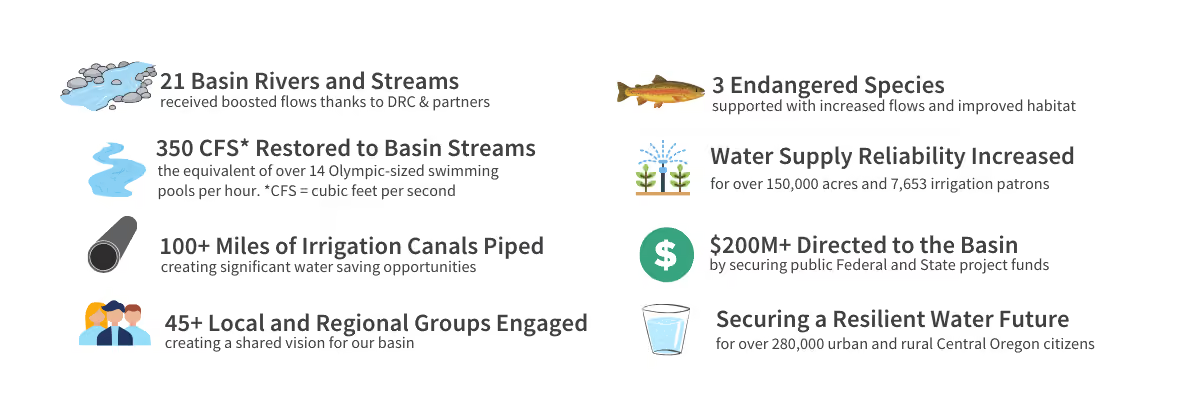
Thirty years later, the cumulative impact of those early transactions, early piping projects, and early relationships is measurable in numbers and visible in our rivers and streams across the basin.
The proof of concept held. The work was real. And the Deschutes Basin, slowly, was beginning to believe it.
Click to Read Chapter 1: How Collaboration Became the Path Forward
Click to Read Chapter 3: Building Momentum: From First Wins to a Basin-Wide Strategy
